pylint
Converts pylint --output-format=json2 into SARIF. Each pylint message symbol becomes a
SARIF rule, unused-import for example, and the rule links to that message's page in the
pylint documentation. The numeric code goes into the rule description, so W0611 is still
there for anyone who reads pylint output that way.
Use json2, not the older json, which pylint's own help calls the old one. Both report
the same findings at the same positions, end line and column included. What json2 adds is
a statistics block, the only part of the output that identifies it as pylint's rather
than any other JSON, and the messageId spelling of the code that the old format writes
as message-id. The old format is a bare array with neither, so sarif-kit refuses it
instead of half-reading it.
Capture the native output
pylint --exit-zero --output-format=json2 src > pylint.json
--exit-zero is the guard here, and it is a better one than || true. pylint encodes
what it found in the exit code as a bit mask (1 fatal, 2 error, 4 warning, 8 refactor,
16 convention), so a run that found something exits nonzero and would otherwise stop the
job before the upload. What --exit-zero does not swallow is 32, a usage error, so a
mistyped flag still fails the step instead of quietly producing nothing.
Run it from the repository root. pylint reports every path relative to the working
directory, even when the target is named absolutely, so from the root they come out
repo-relative on their own and --src-root is not needed. Run it from a subdirectory and
they come out relative to that instead, and the alerts point at paths that do not exist.
--src-root cannot repair that: it rewrites absolute paths, and these are already
relative.
Convert
sarif-kit convert --tool pylint -i pylint.json -o pylint.sarif
Severity mapping
| pylint message type | SARIF level |
|---|---|
| fatal | error |
| error | error |
| warning | warning |
| refactor | note |
| convention | note |
| info | note |
Style-level findings land at note on purpose. Convention and refactor messages are
opinions about style and design, not defects, and they arrive in bulk on any repository
that adopts pylint mid-life; GitHub has one informational tier to hold them, and the
alternative puts line-too-long beside undefined-variable. In the requests capture
sarif-kit tests against, they are 27 of 66 findings.
info messages only appear if you ask for them: locally-disabled and
suppressed-message are off unless the run adds --enable=I. The row is in the table
because the mapping exists, not because a default run produces any.
No security-severity is set, since nothing in pylint's output carries a CVSS score and
sarif-kit does not invent one.
What it looks like
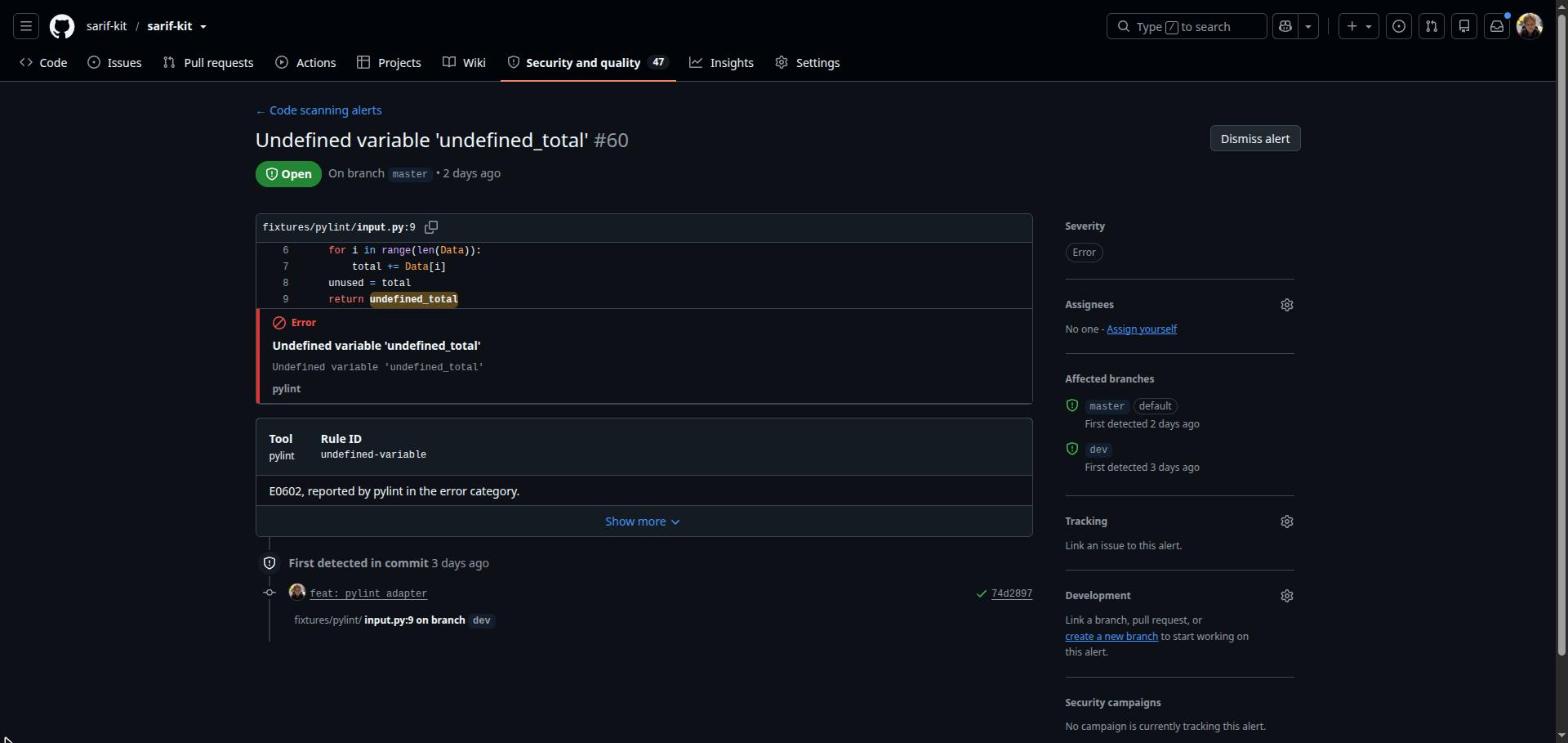
Full workflow example
permissions:
  contents: read
  security-events: write

steps:
  - uses: actions/checkout@v7
  - name: Lint
    run: pipx run pylint --exit-zero --output-format=json2 src > pylint.json
  - name: Convert to SARIF
    uses: sarif-kit/sarif-kit@v0.3.0
    with:
      tool: pylint
      input: pylint.json
      output: pylint.sarif
  - name: Upload to Code Scanning
    uses: github/codeql-action/upload-sarif@v4
    with:
      sarif_file: pylint.sarif
      category: pylint
Notes
- pylint counts columns from zero and SARIF counts from one, so every column shifts by one on the way through. Both formats put the end position one past the last character, so that end lines up too.
- A message carries no description of the check behind it, only the text of the one
occurrence, so the first message a symbol produces becomes the rule's title: for
line-too-long, the rule is titled "Line too long (137/100)". Only its first line is used, becauseduplicate-codequotes the offending source into its message and eight lines of Python make a poor title. The finding keeps the whole text, so the duplicated blocks are still there to read. Two findings of one symbol therefore share a title even when they are about different things, two unused imports for instance; what tells them apart is the message on each alert and the token highlighted in its snippet. - Messages with no end position,
line-too-longamong them, convert to a start position alone rather than an invented range. - Messages longer than 1024 characters are clipped with a
... (truncated)marker, which is GitHub's cap on rule description text. Most pylint messages are nowhere near it, butfixmequotes the whole comment it found, so one long TODO passes it alone. - Messages from a plugin get the right level, since a plugin registers its checks under
one of pylint's own categories:
W5101is a warning like any otherW. Its symbol has no page in the pylint documentation though, so that rule's help link points at one that does not exist. - pylint writes a JSON document even when it finds nothing, so an empty file means the
run itself failed. Converting it would report a clean, green run; sarif-kit exits 2
instead. The same goes for a document that isn't pylint's: naming
--tool pylintfor some other JSON is an error rather than a run with no findings.