PlatformIO check
Converts pio check --json-output into SARIF. pio check drives cppcheck by default
(clang-tidy and PVS-Studio are the alternatives) over a PlatformIO project. Each defect
id becomes a SARIF rule namespaced by the tool that reported it, cppcheck:uninitvar
for example, and when the defect carries a CWE number the rule links to that CWE's page.
Capture the native output
pio check --json-output > pio-check.json
No exit-code guard is needed: pio check exits 0 even when it finds defects. If you
want the check step itself to fail the job, that is what its own --fail-on-defect
flag is for; conversion works either way.
Run it from the project root. The JSON reports absolute paths resolved against the
working directory, and --src-root (below) can only rewrite them if they line up.
On a fresh machine, which includes every CI runner, PlatformIO installs packages first and prints "Tool Manager: Installing..." lines to stdout ahead of the JSON. sarif-kit tolerates that: when the input as a whole is not valid JSON, it parses the last line, which is where the JSON array always ends up.
Convert
sarif-kit convert --tool platformio -i pio-check.json -o pio-check.sarif --src-root .
The defect paths are absolute, so --src-root matters here more than for any other
adapter: it rewrites them relative to your repository root, which is what makes the
file links in GitHub's alerts resolve.
Severity mapping
| pio check severity | SARIF level |
|---|---|
| high | error |
| medium | warning |
| low | note |
The severity comes from the underlying tool; cppcheck's error arrives as high,
warning as medium, and style, performance and portability as low, with the
original class kept in the defect's category field. No security-severity is set:
nothing in the input carries a CVSS score, and sarif-kit does not invent one. Findings
with a CWE keep it as a cwe property on the result. cppcheck reports CWE 0 for checks
that have none assigned; sarif-kit drops it instead of linking to a CWE-0 page that
does not exist.
What it looks like
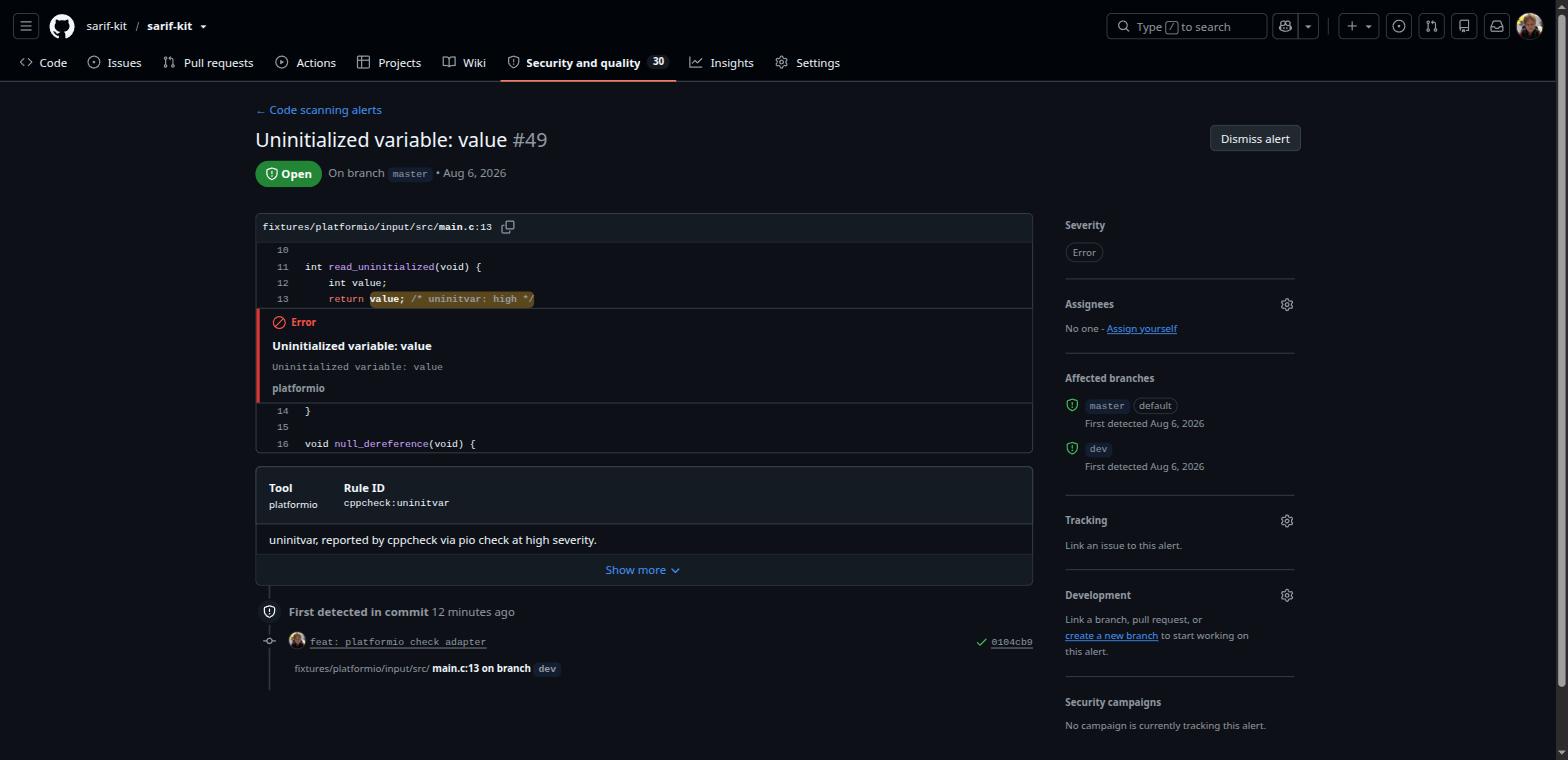
Full workflow example
permissions:
  contents: read
  security-events: write

steps:
  - uses: actions/checkout@v7
  - name: Static analysis
    run: pipx run platformio check --json-output > pio-check.json
  - name: Convert to SARIF
    uses: sarif-kit/sarif-kit@v0.3.0
    with:
      tool: platformio
      input: pio-check.json
      output: pio-check.sarif
      src-root: ${{ github.workspace }}
  - name: Upload to Code Scanning
    uses: github/codeql-action/upload-sarif@v4
    with:
      sarif_file: pio-check.sarif
      category: platformio
Notes
- The same defect reported by several environments (they usually compile the same
src/) is collapsed into a single alert. - A result entry with
"succeeded": falseand no defects means that check run itself failed, and the conversion refuses it with exit 2 rather than uploading an empty, green-looking run. With defects present the flag just means--fail-on-defecttripped, and the findings convert normally. - clang-tidy and PVS-Studio emit the same JSON shape and should convert unchanged, but
the fixtures sarif-kit tests against are cppcheck's, which is what
pio checkruns unless told otherwise. - Messages longer than 1024 characters are clipped with a
... (truncated)marker. GitHub caps rule description text at that length, and in practice an oversized message is cppcheck dumping its entire preprocessor configuration into the text.